
Direct Composite Laminates
Direct anterior and cervical restorations are no longer simple restorative procedures. Today, direct composite laminate preparations demand precision, aesthetics, and strict adherence to adhesive principles to achieve predictable, long-lasting results. More than filling placement, these procedures represent a technique-sensitive restorative …
Overview
Direct anterior and cervical restorations are no longer simple restorative procedures. Today, direct composite laminate preparations demand precision, aesthetics, and strict adherence to adhesive principles to achieve predictable, long-lasting results.
More than filling placement, these procedures represent a technique-sensitive restorative philosophy, where preparation design, isolation, material handling, and contouring directly influence strength, aesthetics, and restoration longevity.
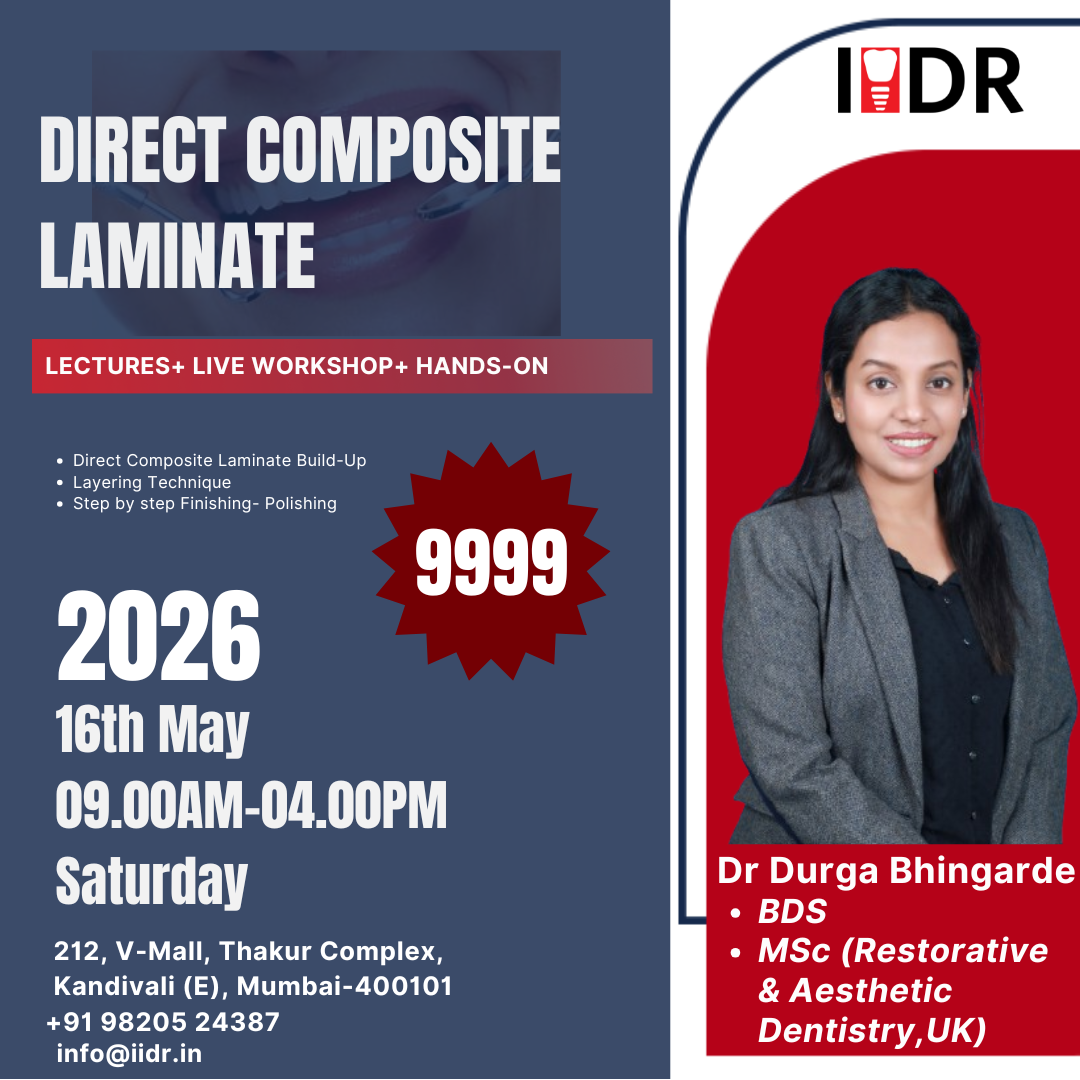
This workshop builds a clear understanding of tooth anatomy–based cavity preparation, defect assessment, and restorative sequencing for cavities, along with conservative and aesthetic approaches to laminates.
It emphasizes proper cavity design, isolation strategies, adhesive protocols, composite layering techniques, and finishing and polishing, while highlighting the limitations and realistic expectations of direct restorative procedures.
Participants will learn structured, step-by-step clinical protocols to prepare and restore, manage laminates. The session also explains how correct preparation and layering improve strength, aesthetics, and long-term clinical performance.
Through clinical demonstrations, case discussions, and hands-on practice, this workshop helps clinicians move from uncertainty to confident, evidence-based restorative execution.
This program directly addresses common challenges such as over- or under-preparation, poor isolation, shade mismatch, contouring errors, black triangles, open contacts, and early restoration failure, providing clear and practical solutions for everyday restorative practice.
Key Takeaways:
-
Principles of cavity preparation
-
Tooth anatomy–guided preparation design
-
Isolation and bonding protocols for reliable adhesion
-
Composite layering techniques for strength and aesthetics
-
Finishing and polishing for natural contours
-
Avoiding common errors in anterior and cervical restorations
Join Dr Durga Bhingarde for this hands-on workshop designed to strengthen your clinical precision and aesthetic confidence on IIDR.
May 16th, 2026
Enroll with IIDR to master Direct Composite Laminates—because in restorative dentistry, precision determines predictability.
Curriculum
- 2 Sections
- 3 Lessons
- 10 Weeks
- Introduction2
- About the Event1
Instructor

FAQs
Requirements
- Understanding of tooth anatomy, cavity classification, and basic composite restorative principles.
- Prior experience in performing direct restorations in anterior and cervical teeth is recommended.
- Basic knowledge of bonding systems, isolation techniques, and composite materials.
- Willingness to actively participate in practical exercises and follow step-by-step protocols.
- Standard restorative instruments and materials will be demonstrated; any specific items will be communicated in advance.
- General dental practitioners, postgraduate students, interns, and clinicians interested in improving anterior and cervical restorative outcomes.
Features
- Emphasis on practical execution with guided exercises and demonstrations.
- Preparation principles based on tooth morphology for Class III, IV, and V lesions.
- Structured workflows from diagnosis to finishing and polishing.
- Correct use of bonding systems and isolation techniques for predictable results.
- Strategies for strength, shade matching, and natural aesthetics.
- Conservative, aesthetic approaches to space closure with proper contours and contacts.
- Managing common issues such as black triangles, open contacts, overcontouring, and marginal staining.
- Techniques that can be directly implemented in routine clinical practice.
Target audiences
- General dental practitioners seeking to improve anterior and cervical restorative outcomes
- Postgraduate students and interns in Conservative Dentistry and Endodontics
- Early- to mid-career clinicians looking to refine composite techniques
- Academicians and faculty involved in teaching restorative dentistry
- Clinicians interested in aesthetic dentistry and minimally invasive restorations
You May Like

Veneers
In today’s image-conscious world, aesthetic dentistry is no longer optional—it’s an essential component of modern dental practice. Among the most popular and impactful cosmetic solutions...

The Art and Science of Shade Selection in Aesthetic Dentistry
The art and science of shade selection in composite dentistry involves the precise matching of dental composite materials to the natural color of a patient’s...
Course Features
- Lectures 3
- Quiz 0
- Duration 10 weeks
- Skill level All levels
- Language English
- Students 4
- Certificate No
- Assessments Yes