
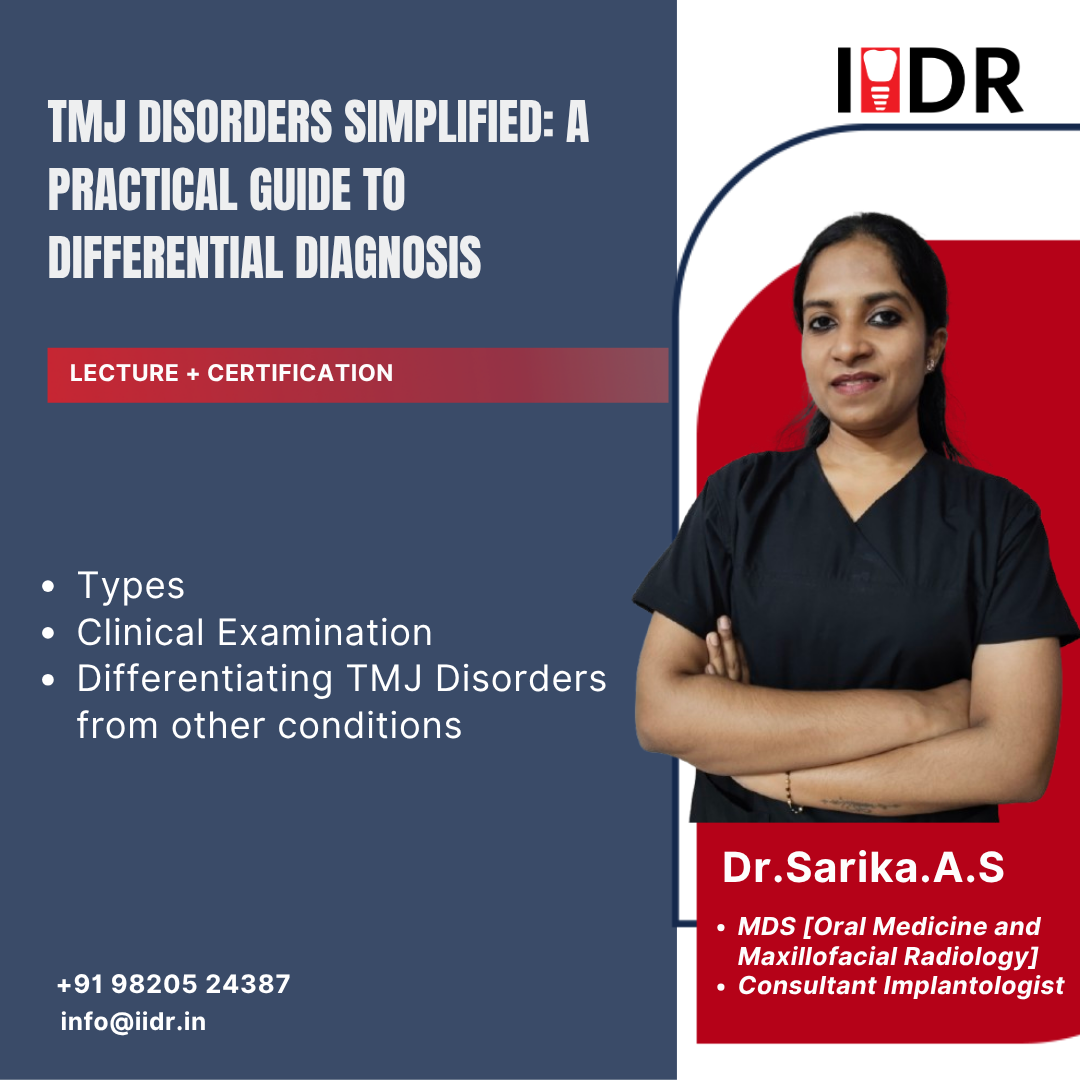
TMJ Disorders Simplified: A Practical Guide to Differential Diagnosis
Temporomandibular joint disorders can present with a wide range of symptoms, from jaw pain and clicking to restricted movement, headaches, and facial discomfort. Because these symptoms can overlap with other dental and orofacial conditions, arriving at the correct diagnosis can …
Overview
Temporomandibular joint disorders can present with a wide range of symptoms, from jaw pain and clicking to restricted movement, headaches, and facial discomfort. Because these symptoms can overlap with other dental and orofacial conditions, arriving at the correct diagnosis can often be challenging.
This lecture will provide a simplified, systematic approach to evaluating patients with suspected TMJ disorders. It will focus on connecting the patient’s history and clinical findings to the appropriate differential diagnosis, helping clinicians avoid common diagnostic pitfalls and make more informed treatment or referral decisions.
Key Highlights
- Understanding the different clinical presentations of TMJ disorders.
- A structured approach to patient history and clinical examination.
- Recognizing important signs and symptoms that guide diagnosis.
- Differentiating TMJ disorders from other sources of orofacial pain.
- Understanding the clinical significance of joint sounds, pain, and restricted movements.
- Identifying cases that require further investigation or specialist referral.
- Applying diagnostic reasoning to real-world clinical cases.
Join Dr. Sarika A S on IIDR for an engaging, clinically focused session that simplifies TMJ diagnosis and helps you approach patients with greater clarity and confidence.
Curriculum
- 3 Sections
- 4 Lessons
- 2 Weeks
- Introduction2 Items
- About the Event2 Items
- Quiz1 Item
Instructor

FAQs
Requirements
- Basic understanding of TMJ anatomy and function.
- Familiarity with routine dental history-taking and clinical examination.
- Basic knowledge of common orofacial pain conditions.
- Interest in strengthening TMJ assessment and differential diagnostic skills.
- Suitable for general dentists, BDS students, interns, and postgraduate students.
- No prior advanced training in TMD required.
Features
- Simplified approach to the differential diagnosis of TMJ disorders.
- Systematic evaluation of patient history and clinical findings.
- Practical approach to assessing TMJ pain, joint sounds, and restricted movements.
- Differentiation of TMJ-related symptoms from other causes of orofacial pain.
- Recognition of common diagnostic pitfalls in everyday practice.
- Guidance on when further investigations or specialist referral may be required.
- Clinical case discussions to strengthen diagnostic reasoning.
- Practical clinical pearls for confident TMJ assessment and decision-making.
Target audiences
- General Dental Practitioners (GDPs)
- BDS Students & Interns
- MDS Students and Postgraduate Residents
- Early-career dentists managing patients with TMJ-related complaints
- Clinicians looking to strengthen their TMJ examination and differential diagnostic skills
- Dentists seeking a structured approach to evaluating orofacial pain and TMD cases
You May Like
Mastering Full Mouth Rehabilitation: From Diagnosis to Final Delivery (1 Day Lecture)

Full Mouth Rehabilitation (FMR) requires a systematic approach to diagnosis, occlusal analysis, and treatment planning. It also involves precise restorative execution. Therefore, clinicians must carefully...

Oral Habits and Their Management

Oral habits such as thumb sucking, tongue thrusting, mouth breathing, lip biting, and prolonged pacifier use can influence dental development and occlusion, particularly during childhood....

Journey from Surgery to a Prescribing Pad: A Guide from a UK-Trained Dentist

Journey from Surgery to a Prescribing Pad is how prescribing is an important part of post-operative dental care. Choosing the prescription drug, dose, duration, and...

Extraction Vs Non-Extraction: A Clinical Decision Making Approach

Orthodontic treatment planning often requires a careful decision between extraction and non-extraction approaches. The choice depends on factors such as crowding, facial profile, arch dimensions,...
The New Era of Pediatric Dentistry: Advances in Crowns, Preformed Space Maintainers, and Prevention

Pediatric dentistry continues to evolve with advances in restorative materials, prefabricated treatment options, and preventive strategies that help clinicians provide more predictable and child-friendly care....
Course Features
- Lectures 4
- Quiz 1
- Duration 2 weeks
- Skill level All levels
- Language English
- Students 39
- Certificate No
- Assessments Yes